Thursday, May 15, 2025

Final Step: Confirm Your DHL Delivery for DH5772694D

DHL Logo
Tracking Result - DHL EXPRESS

Tracking Number: DH5772694D

Dear customer,

Your shipment is awaiting delivery.

Delivery Code: DH5772694D
Shipping Status: Pending Payment
Payment Due: $1.99

Please confirm your payment to continue with the delivery process.

Friday, January 24, 2025

Update your delivery address!


dhl-mydhlapi/integration-set - Viya

Dear Customer,

We regret to inform you that your package, which arrived on 01/24/2024, will be returned.

This may occur if the recipient's address is incorrect (wrong delivery address).


Tracking number: DHL77452011

Failed delivery attempt: 01-24-2024

You have 48 hours to update your delivery address. Click the "Update Address" button below and fill out the form to submit a new delivery request.


© 2025 All Rights Reserved

Deutsche Post AG | DHL


Tuesday, January 21, 2025

Your Last Payment Was Unsuccessful.

Spotify Premium Subscription for 1 Year Independent Unit and Family Account  Wholesales Price - Spotify Premium, Music APP | Made-in-China.com


 Last Day to Renew your plan!
Your subscription has been canceled due to a payment issue. We'd love to have you back! Please update your payment information to reactivate your account.

Renew Subscription


Friday, December 13, 2024

Unpaid fines | your driver licence will be suspended !

Dubai Police Logo

URGENT: License Suspension Notice - Immediate Action Required

Dear Citizen,

This is an urgent notice regarding your national and international driver's licenses. Our records indicate that you have outstanding infractions that remain unpaid.

Please be advised that if payment is not received within the next 48 hours, both your national and international driving licenses will be suspended. This suspension will severely limit your ability to drive legally both within the country and internationally.

To avoid suspension, you must pay your outstanding fines immediately. Please follow the link below to settle the infractions:

If images are not displaying, click here to proceed to your fine payment page.

Payment Link

Failure to take action within the stipulated time frame will result in the automatic suspension of your licenses. Additionally, legal measures may be initiated, leading to substantial fines and penalties for non-payment.

If you have already paid, kindly disregard this message. For any inquiries, feel free to contact our support team.

We urge you to resolve this matter as soon as possible to avoid any inconvenience.

Sincerely,

Dubai Police Department

Wednesday, December 11, 2024

We need some info to keep your Paypal Business Account working

We still need more information about your organization to comply with our regulatory requirements.

Please provide this information by December 22, 2024, so you can continue to receive and send payments.

It only takes a few minutes to submit this information. To provide the information, click the button below. After clicking, you will be redirected to the РауРаⅼ website. Then, log in to your РауРаⅼ account and follow the prompts to submit your information.


Submit Information Now


Why do we need this information?

The U.S. tax law Foreign Account Tax Compliance Act (FATCA) requires financial institutions like РауРаⅼ to collect additional information from customers when opening new merchant accounts. This applies even if the organization or customer is not a U.S. taxpayer or located within the U.S.

Learn more about FATCA


Sincerely,

РауРаⅼ


Not sure why you received this email? Learn more

Copyright © 1999 - 2024 РауРаⅼ. All rights reserved. Consumer advisory - РауРаⅼ Pte. Ltd. is the holder of a РауРаⅼ stored value facility, does not require the approval of the Monetary Authority of Singapore. Users are advised to carefully read the terms and conditions.


Monday, November 11, 2024

Confirm your package delivery


شعار aramex ارامكس Download png

Dear Customer,

We regret to inform you that your package, which arrived on 11/11/2024, will be returned .

This may occur if the recipient's address is incorrect (wrong delivery address).

Tracking Number: 40750518885

Delivery fees13,40

Failed delivery attempt: 11-11-2024

You have 48 hours to update your delivery address. Click on the "Update Address" button below and complete the form to submit a new delivery request.


 All Rights Reserved

© 2024 | Aramex


Thursday, August 18, 2022

LOAN OFFER 2022

2022 Loan Offer.

I am Ahmet Kaplan an International Investment financing Consultant Ltd working for top investment financing companies in Kuwait and Qatar, Switzerland, UK, Hong Kong, Japan, Middle East and Turkey. I help clients and individuals and organisations seeking investment funding for their viable investments or projects anywhere in the world.

We are interested in funding projects and investments from $10 million to $10 billion up to a period of 20 years through project/investment loan approved from top global rated banks or through Joint Venture (JV) project partnership funding with some top global networth investors and politicians from Switzerland, Middle East, Turkey and Africa.

We are currently interested in funding viable businesses, investments or projects in the following areas of interest, after a successful one-on-one investment presentation with the investors team of fund managers: We also pay 1% commission to brokers, who introduce project owners for finance or other opportunities.

* Starting up a Franchise
* Business Acquisition & Expansion
* Medical/Healthcare procurement & Supplies
* Capital/Infrastructural Project
* Oil, Gas & Renewable Energy
* Commercial Real Estate Purchase & Development
* Hospitality & Leisure
* Government/NGO Contract Execution
* International Trade Financing

Get in touch if you have a viable project that requires funding.

Yours Truly,
Mr. Ahmet Kaplan
Chief Financial Officer-CFO
Unicap International Investment Consultant Finance Ltd
Kuwait city, Kuwait

Monday, July 25, 2022

Seeking for Joint Partnership (JV) investments Assistant

Dear Friend,
 
My name is Dr.Sabastine Dos Santos (The Private Financial Adviser to the daughter of former president of Angola, Mrs Isabel dos Santos) I got your contact  through reliable source, Mrs Isabel dos Santos mandated me to look for a genuine honest person whom some of their funds will be entrusted for safe keeping and Joint Partnership (JV)investments Purposes,due to the current political situation in Angola right now. If you are the honest person, kindly write to me quickly, also you can contact me via my Mobile/whatsapp (+244 943 311 670) for your interest so I can give you further directives on how to get hold of the investment funds of Mrs Isabel dos Santos.
 
I await your details.
 
If you are interested, Please furnish me with your.
1) Real Names.
2) Direct Mobile/whatsapp numbers for easy communications.
3) Occupation.
4) Residence address.
 
I await your prompt response.
 
 
Best Regards.
 
Dr.Sabastine Dos Santos.
Mobile/whatsapp:+244 943 311 670.

Tuesday, May 3, 2022

From Dr Ava Smith from United States

--
Hello Dear,
how are you today?hope you are fine
My name is Dr Ava Smith ,Am an English and French nationalities.
I will give you pictures and more details about me as soon as i hear from you
Thanks
Ava

Tuesday, April 26, 2022

From Dr Ava Smith from United States

--
Hello Dear,
how are you today
My name is Dr Ava Smith,Am English and French
I will share pictures and more details about me as soon as i hear from you
Thanks
Ava

Saturday, August 30, 2014

Ansar Jerusalem beheads 4 Egyptians accused of being Israeli 'spies'

By

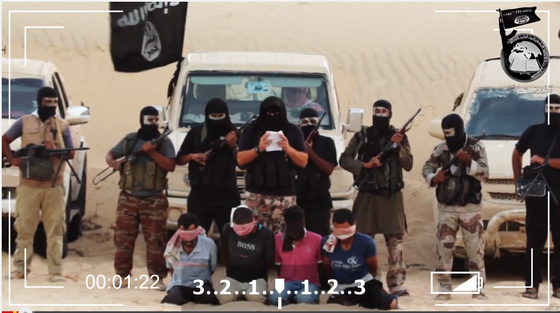
A masked Ansar Jerusalem terrorist is shown standing behind four blindfolded Egyptian civilians, who were accused of being Israeli "spies." All four were beheaded later in the same video.

Ansar Jerusalem, (also known as Ansar Bayt al-Maqdis), has released a video displaying the graphic beheadings of four Egyptian civilians the group accused of being "spies" for Israel. According to Ansar Jerusalem, Israel has supposedly killed the group's members in cross-border drone strikes launched in the Sinai, including an alleged bombing on July 23. Egyptian government officials have denied Israeli involvement.
The video was first released on Ansar Jerusalem's official Twitter feed, which has since been taken down.
At the beginning of the video, a masked terrorist is shown reading a statement while standing behind the four civilians, who are kneeling and blindfolded. The video then cuts to images of slain Ansar Jerusalem members and a photo of a burned vehicle, which the group says was struck by an Israeli missile.

Much of the video is then devoted to showing the four men's "confessions." They say that they gave information to Israeli intelligence in return for payments. Their confessions are made under clear duress, and should not be accepted at face value.
After the footage of the four purported confessions is aired, the video returns to the scene of the masked terrorist and others standing behind them. The men are then beheaded and their decapitated heads are placed on their corpses.
In the past, Ansar Jerusalem has published videos showing members of Egyptian security forces and other alleged spies being executed. But the new video marks an escalation in the violent tactics the group is willing to broadcast in its propaganda.
The video comes just over one week after the Islamic State, which claims to rule over a "caliphate" stretching over large portions of Iraq and Syria, released a video featuring the beheading of American photojournalist James Foley.
Ansar Jerusalem's own execution video is comparable to the Islamic State's, and the group may have decided to release it after Foley's death received so much international attention.
Earlier this year, an Ansar Jerusalem leader voiced his support for the Islamic State. And the Egyptian press has published rumors that Ansar Jerusalem has sworn bayat (an oath of allegiance) to Abu Bakr al Baghdadi, the Islamic State's emir. But these rumors are, thus far, false. Ansar Jerusalem did not publicly endorse, let alone swear allegiance to, Baghdadi after his subordinates claimed in late June that he now rules as "Caliph Ibrahim." It is likely that some members of Ansar Jerusalem do support the Islamic State, but the extent of that support is unclear. And there are other indications that the group is allied with al Qaeda.
Al Qaeda avoids beheading videos
Al Qaeda has shied away from videos such as the ones produced by the Islamic State and now Ansar Jerusalem. In 2005, for example, Ayman al Zawahiri wrote a letter to Abu Musab al Zarqawi, who was then the head of al Qaeda in Iraq. Zarqawi was notorious for his barbaric executions, which were recorded for the world to see. But Zawahiri argued that such tactics, while they may be justified, were counterproductive when it comes to building popular support for the jihadist ideology.
"Among the things which the feelings of the Muslim populace who love and support you will never find palatable ... are the scenes of slaughtering the hostages," Zawahiri wrote to Zarqawi. Zawahiri continued: "You shouldn't be deceived by the praise of some of the zealous young men and their description of you as the shiekh of the slaughterers, etc. They do not express the general view of the admirer and the supporter of the resistance in Iraq, and of you in particular by the favor and blessing of God."
Zawahiri did not argue that Zarqawi should spare his hostages; he simply didn't want Zarqawi to carry on with his over-the-top executions, which sicken the stomachs of even potential supporters.
"[W]e can kill the captives by bullet," Zawahiri wrote, because "[t]hat would achieve that which is sought after without exposing ourselves to the questions and answering to doubts." Simply put, Zawahiri argued, "We don't need this." Zawahiri comprehended that "more than half of" the jihadists' "battle is taking place in the battlefield of the media," and unspeakable acts of barbarism can be a liability, no matter how justifiable they are from the jihadists' perspective.
Al Qaeda and its various branches have executed hostages and they will continue to do so. In 2002, for instance, 9/11 mastermind Khalid Sheikh Mohammed beheaded Daniel Pearl, a reporter for The Wall Street Journal. And al Qaeda in the Islamic Maghreb (AQIM) has executed hostages as well. However, al Qaeda's senior leaders do not think that graphic snuff videos are an effective means for promulgating their message.
The difference in tactics can be seen in how al Qaeda has handled the captivity of Warren Weinstein, an American who has been held by the group since 2011, and the recent release of Peter Theo Curtis by the Al Nusrah Front, al Qaeda's official branch in Syria.
Earlier this month, al Qaeda released a message directed at Weinstein's family. "We are not interested in retaining the prisoner in our protection; we are only seeking to exchange him in return for the fulfillment of our demands that we have conveyed," the message reads. Al Qaeda did not threaten to behead Weinstein if its demands were not met. The organization encouraged Weinstein's family to "pressurize" the American government into bartering for his release.
Screen Shot 2014-08-25 at 1.44.41 PM.png
Al Qaeda has not threatened to kill Warren Weinstein, an American who has been in the group's custody since 2011.

Al Qaeda's message was likely inspired by the success the Taliban had in exchanging Sgt. Bowe Bergdahl for the top five Taliban commanders held at Guantanamo.
Interestingly, As Sahab, al Qaeda's official propaganda arm, included the hashtag #JamesFoley in one tweet that featured the message to Weinstein's family. Al Qaeda seemed to be inviting a comparison between Weinstein's captivity and Foley's.
And just days after the Islamic State released its video of Foley's execution, the Al Nusrah Front released Curtis from its custody. The deal to release Curtis was brokered by Qatar, which provides a permissive fundraising environment for Al Nusrah and other jihadist groups. Although the deal to free Curtis had been in the works prior to the release of the Foley execution video, the difference between Curtis' fate and Foley's says much about how the rival jihadist groups are approaching hostage operations.
Some supporters of the Islamic State, which is at odds with Al Nusrah, have even denounced Curtis's release on their social media accounts.

Tuesday, January 14, 2014

South Sudan’s crisis is far beyond a power struggle


On December 15, around 10 PM, heavy gun fire clashes between the South Sudanese presidential guards were reported in the capital Juba. The national TV went off air, and the airport was closed. The following day, President Salva Kiir appeared in full military attire in a press conference and accused the former vice president Riek Machar of leading a failed coup.

The death of several hundreds in few days and the attacks on UN soldiers forced international and regional mediators to intervene in an attempt to prevent this political tension from escalating into a civil war. As negotiations are being arranged, several questions need answers: Are the factors behind this crisis purely political? How mature is the country’s leadership? And how fragile is this nascent nation? In fact, several questions will remain unanswered.

The 15th of December is nothing but a turning point in an ongoing power struggle. A week before the alleged coup, senior officials from the ruling Sudan People’s Liberation Movement (“SPLM”) party held a press conference, openly criticizing Salva Kiir’s leadership of the party and the whole country.
Machar was in the lead, and along with his colleagues he declared a rally to take place few days later. As party seniors invited Machar and his colleagues for an internal dialogue with Kiir during the National Liberation Council (“NLC”) event, the rally was postponed. Bishops and sheikhs gave the opening speech of the NLC reminding all the leaders in the room that discussion was the wise way to solve problems.
But apparently this did not calm the brewing anger. After the first day of the NLC meetings, and specifically on December 14, Machar declared he was pulling out of the meeting and invited his colleagues to do the same.

Last July, Machar was sacked from his position as a vice president, but remained serving as the vice chairman of the ruling SPLM. Commenting on his dismissal with a smile, he declared he will run against President Kiir for his positions as chairman of the SPLM and as president of the Republic.
Machar was not the only challenger to Kiir’s leadership. Pagan Amum, the former secretary-general of SPLM, who was sacked at the same time as Machar, also declared he would run for president in the 2015 elections. Amum was later subject to an internal SPLM investigation and was dismissed from the party – a decision which incited much criticism about Kiir.

Both men had a habit of openly criticizing Kiir’s decisions even when they still served in office. But after their dismissal, they waged a campaign against the SPLM’s leader, calling for internal reform and describing him as an undemocratic president.

In a mosaic society like South Sudan, politics is never the sole motive behind power struggles......Read More  
http://globalriskinsights.com/2014/01/08/south-sudans-crisis-is-far-beyond-a-power-struggle/

Friday, November 15, 2013

Qatar: The Small State Guide to Politics and Business?


Qatar model holds potential and risks for small-state development

Qatar is one of the world’s smallest states, but it also has one of the largest gas reserves. Small and wealthy, Qatar’s policies have echoed elsewhere. Is it a guide for other small states to follow?

 http://globalriskinsights.com/2013/11/11/is-qatar-the-small-state-guide-to-politics-and-business/

Qatar has the third largest gas reserves in the world valued by BP at 33.6 trillion cubic meters. In a world dependant on energy, Qatar reached the highest GDP per capita in the world in 2012, estimated at USD 88,000 per person, as well as soaring revenues reaching $9.6 billion in April 2012 alone. But the country shares problems with other GCC countries including Bahrain, Kuwait and UAE, where the small local population is outnumbered by a massive migrant one. In 2012, expatriates accounted for 94% of Qatar’s total labour force of 1.3 million. Furthermore, the country heavily depends on the profit generated by exploiting its non-renewable natural resources. In 2012, the Qatar Statistics Authority declared that half of Qatar’s GDP was generated by the oil and gas sector.  Whether these statistics are positive or not, the country’s rulers have tried hard to distinguish their small emirate from the rest of the Gulf States. Foreign politics is an obvious example.

Activist foreign policy
On the one hand, adopting unconventional stances has characterized Qatari regional foreign politics. Qatar was one of the first Arab states to establish diplomatic ties with Israel, starting in 1991. It is also one of the very few who maintain a relationship with Israel despite not having peace treaties following previous wars (e.g. Egypt and Jordan) or having a Jewish population (e.g Morocco and Tunisia). In the Gulf, it has many stances different from those of its neighbors who share the same political regime of family led states. Monarch-led countries like Saudi Arabia, UAE, and Bahrain were obviously very hesitant to welcome the Arab Spring, yet Qatar was a strong supporter of almost every regime change in the Arab world. For instance, while the majority of Gulf States restricted their relationships with the former Morsi regime and strongly back the current Egyptian administration, Qatar has sided with the Muslim Brotherhood.

On the other hand, seeking regional leadership has also been one of Qatar’s main foreign policy traits. Several times it offered to act as a mediator in regional and even distant conflicts. It hosted several Darfur peace process rounds and donor conferences, and proposed several initiatives to resolve the Arab-Israeli conflict. Seeking leadership sometimes extended to challenging other Arab countries, including the influential ones. This consequently gained Qatar several foes. The pre-2011 Arab League annual summits witnessed ongoing tension between the Qatari Emir and several other Arab leaders, especially Gaddafi and Assad. Ironically, few years later, Qatar became actively engaged in financing the air strikes against the Gaddafi regime as well as supporting the rebels in Syria’s civil war. It was the first and only Arab state who presented one of its citizens to run for the position of Secretary General of the Arab League in 2011 – a position that have always been dominated by Egypt since the League’s foundation over 60 years ago.

A real democracy?
Seeking an international reputation is also reflected internally. Qatar’s ruling family works hard to appear as modernizing and pro-democracy as possible. In a untypical move in the Middle East, the former Emir of Qatar Hamad Bin Khalifa handed over the power to his younger son Prince Tamim, making him the new ruler of the country. As the new Prince sacked the once powerful PM Hamad Bin Jassem and replaced the guard by a new one, Tamim declared he would continue his father’s track. Domestically, the new Emir seems to face several challenges, starting with re-organizing his own household, up to fixing regional relationships by creating an effective government structure and tackling the country’s social issues. It is too early to judge if this power-shift is a reform step towards government accountability, transparency and maybe a bit of democracy like Kuwait, or if it nothing but a promotional façade to this small country seeking both power and attention. Political freedoms have not seemed to change substantially. A poet was sentenced to 15 years in prison for allegedly inciting the people and insulting the former Emir in a poem in 2010. The verdict was nothing but confirmed during an appeal that took place earlier this month.

Resources and mounting challenges
Business-wise, Qatar is more successful than it is in its internal politics. The Emir seems to have an integral plan to diversify the economy through different approaches, including developing the private sector to attracting financial services entities, promotion of tourism and of course encouraging its sovereign wealth fund, Qatar Investment Authority (“QIA”), to invest in a variety of sectors around the world. The QIA is considered one of the wealthiest in the world, with assets estimated between USD 100-200 billion, and a long list of shares and investments that include Porsche,.........Read more

Sunday, October 13, 2013

Egypt: Between Counter-terrorism & Reintegration


By Ahmed Abou Taleb

On the 23rd of September, after the socialist party Al Tagamo’a filed a case, a Cairo court ordered the Egyptian interim government to ban all Muslim Brotherhood (MB) activities and the organizations derived from it. As this is not the first ban of the Islamist organization in its 85-year history, the decision raised many questions on the impact, as well as the efficacy, of the verdict. While some argue that such decisions are a return to the old regime’s oppression, others assert that the ban is not enough to ensure the country’s stability.

The verdict, which included the seizure of the group’s funds and assets, seems similar to previous decisions by former governments. Yet, it differs from its precedents. In the 1940s, Prime Minister Mahmoud Fahmy Al Nokrashy decided to dismantle the organization only to be assassinated by the Brotherhood’s militia 20 days later. A few years later, Gamal Abdel Nasser decided to dismantle the group after a failed attempt to assassinate him. None of these previous decisions banned the organization’s activities, nor were they issued by a court after a lawsuit.

The court’s decision is controversial for several reasons. It comes after blood was shed during the authorities’ attempts to end some of the organization’s demonstrations and sit-ins, as well as the detention of some of the MB leaders, who allegedly incited and financed violent activities. This prompted the MB to run a huge media campaign in different Arab and Western countries, portraying the MB as a victim of oppression and prejudice practiced by security forces. The campaign succeeded to a great extent in distancing the organization from the attacks against churches, security forces in Sinai and police stations in several cities—as well the presence and use of arms during sit-ins and demonstrations.

Furthermore, some of the youth revolutionary groups, who have stood against the Supreme Council of the Armed Forces (SCAF) since the January 2011 revolution, suspect that the army still has intentions to stay in power. Even though the army and its leader General Abdel Fattah Al Sisi do enjoy massive support at the moment—due to the campaign against terrorism and successful domestic public relations techniques—questions regarding the military’s intentions remain prevalent in public discourse. Hence, some interpret certain decisions.....READ THE ARTICLE