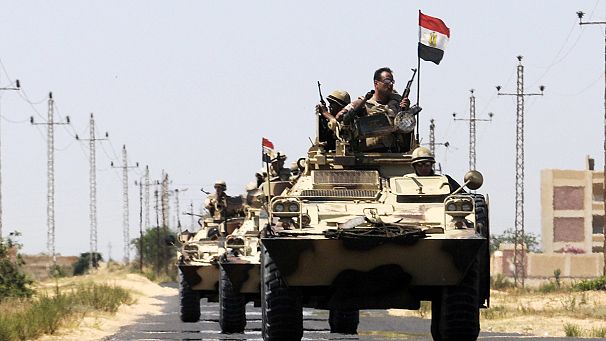
Showing posts with label terrorism. Show all posts

Saturday, August 30, 2014

Ansar Jerusalem beheads 4 Egyptians accused of being Israeli 'spies'

By

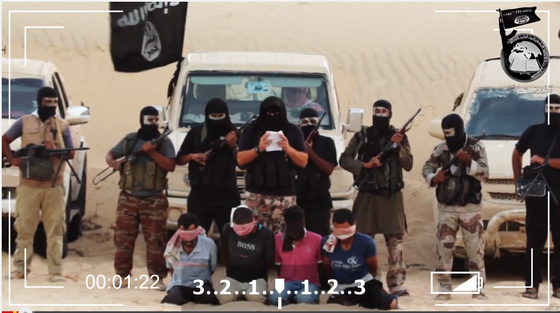
A masked Ansar Jerusalem terrorist is shown standing behind four blindfolded Egyptian civilians, who were accused of being Israeli "spies." All four were beheaded later in the same video.

Ansar Jerusalem, (also known as Ansar Bayt al-Maqdis), has released a video displaying the graphic beheadings of four Egyptian civilians the group accused of being "spies" for Israel. According to Ansar Jerusalem, Israel has supposedly killed the group's members in cross-border drone strikes launched in the Sinai, including an alleged bombing on July 23. Egyptian government officials have denied Israeli involvement.
The video was first released on Ansar Jerusalem's official Twitter feed, which has since been taken down.
At the beginning of the video, a masked terrorist is shown reading a statement while standing behind the four civilians, who are kneeling and blindfolded. The video then cuts to images of slain Ansar Jerusalem members and a photo of a burned vehicle, which the group says was struck by an Israeli missile.

Much of the video is then devoted to showing the four men's "confessions." They say that they gave information to Israeli intelligence in return for payments. Their confessions are made under clear duress, and should not be accepted at face value.
After the footage of the four purported confessions is aired, the video returns to the scene of the masked terrorist and others standing behind them. The men are then beheaded and their decapitated heads are placed on their corpses.
In the past, Ansar Jerusalem has published videos showing members of Egyptian security forces and other alleged spies being executed. But the new video marks an escalation in the violent tactics the group is willing to broadcast in its propaganda.
The video comes just over one week after the Islamic State, which claims to rule over a "caliphate" stretching over large portions of Iraq and Syria, released a video featuring the beheading of American photojournalist James Foley.
Ansar Jerusalem's own execution video is comparable to the Islamic State's, and the group may have decided to release it after Foley's death received so much international attention.
Earlier this year, an Ansar Jerusalem leader voiced his support for the Islamic State. And the Egyptian press has published rumors that Ansar Jerusalem has sworn bayat (an oath of allegiance) to Abu Bakr al Baghdadi, the Islamic State's emir. But these rumors are, thus far, false. Ansar Jerusalem did not publicly endorse, let alone swear allegiance to, Baghdadi after his subordinates claimed in late June that he now rules as "Caliph Ibrahim." It is likely that some members of Ansar Jerusalem do support the Islamic State, but the extent of that support is unclear. And there are other indications that the group is allied with al Qaeda.
Al Qaeda avoids beheading videos
Al Qaeda has shied away from videos such as the ones produced by the Islamic State and now Ansar Jerusalem. In 2005, for example, Ayman al Zawahiri wrote a letter to Abu Musab al Zarqawi, who was then the head of al Qaeda in Iraq. Zarqawi was notorious for his barbaric executions, which were recorded for the world to see. But Zawahiri argued that such tactics, while they may be justified, were counterproductive when it comes to building popular support for the jihadist ideology.
"Among the things which the feelings of the Muslim populace who love and support you will never find palatable ... are the scenes of slaughtering the hostages," Zawahiri wrote to Zarqawi. Zawahiri continued: "You shouldn't be deceived by the praise of some of the zealous young men and their description of you as the shiekh of the slaughterers, etc. They do not express the general view of the admirer and the supporter of the resistance in Iraq, and of you in particular by the favor and blessing of God."
Zawahiri did not argue that Zarqawi should spare his hostages; he simply didn't want Zarqawi to carry on with his over-the-top executions, which sicken the stomachs of even potential supporters.
"[W]e can kill the captives by bullet," Zawahiri wrote, because "[t]hat would achieve that which is sought after without exposing ourselves to the questions and answering to doubts." Simply put, Zawahiri argued, "We don't need this." Zawahiri comprehended that "more than half of" the jihadists' "battle is taking place in the battlefield of the media," and unspeakable acts of barbarism can be a liability, no matter how justifiable they are from the jihadists' perspective.
Al Qaeda and its various branches have executed hostages and they will continue to do so. In 2002, for instance, 9/11 mastermind Khalid Sheikh Mohammed beheaded Daniel Pearl, a reporter for The Wall Street Journal. And al Qaeda in the Islamic Maghreb (AQIM) has executed hostages as well. However, al Qaeda's senior leaders do not think that graphic snuff videos are an effective means for promulgating their message.
The difference in tactics can be seen in how al Qaeda has handled the captivity of Warren Weinstein, an American who has been held by the group since 2011, and the recent release of Peter Theo Curtis by the Al Nusrah Front, al Qaeda's official branch in Syria.
Earlier this month, al Qaeda released a message directed at Weinstein's family. "We are not interested in retaining the prisoner in our protection; we are only seeking to exchange him in return for the fulfillment of our demands that we have conveyed," the message reads. Al Qaeda did not threaten to behead Weinstein if its demands were not met. The organization encouraged Weinstein's family to "pressurize" the American government into bartering for his release.
Screen Shot 2014-08-25 at 1.44.41 PM.png
Al Qaeda has not threatened to kill Warren Weinstein, an American who has been in the group's custody since 2011.

Al Qaeda's message was likely inspired by the success the Taliban had in exchanging Sgt. Bowe Bergdahl for the top five Taliban commanders held at Guantanamo.
Interestingly, As Sahab, al Qaeda's official propaganda arm, included the hashtag #JamesFoley in one tweet that featured the message to Weinstein's family. Al Qaeda seemed to be inviting a comparison between Weinstein's captivity and Foley's.
And just days after the Islamic State released its video of Foley's execution, the Al Nusrah Front released Curtis from its custody. The deal to release Curtis was brokered by Qatar, which provides a permissive fundraising environment for Al Nusrah and other jihadist groups. Although the deal to free Curtis had been in the works prior to the release of the Foley execution video, the difference between Curtis' fate and Foley's says much about how the rival jihadist groups are approaching hostage operations.
Some supporters of the Islamic State, which is at odds with Al Nusrah, have even denounced Curtis's release on their social media accounts.
Tuesday, May 28, 2013

On Security, Violence, Al Qaida, Policy & the Army in Sinai...

May 16 Kidnapping Sparks Security Policy Debate in Egypt
May 27, 2013 | Ahmed Abou Taleb

http://globalriskinsights.com/2013/05/27/may-16-kidnappings-indicative-of-insecurity-in-sinai/


On the 16th of May a group of gunmen conducted a daring attack against Egyptian security forces in Sinai . They kidnapped seven people, of which six were border control police and one an army soldier, who were heading back to their homes to spend their holiday. Seven days after the kidnapping the soldiers were freed. Although this is not the first time security personnel have been kidnapped in Sinai this group in particular were received by the President, the Minister of Defense and the Minister of Internal Affairs.

The incident, which led to a strike among border control police officers, resulted in the launch of a military operation to free the soldiers. It also provoked a wider debate on security on the Sinai peninsula, raising questions on whether it has became a new base for Al Qaida in the region. Likely, it draws attention to Egypt’s changing security policy under the country’s new leadership and the potential repercussions on the relationships with both Palestinians and Israelis.

Kidnapping is one of the many sorts of violence used against security authorities in Egypt after the revolution. It became a frequently employed technique by Bedouin tribes in order to contest government decisions or demand the release of condemned and sentenced members of the tribe. While usually used against tourists, kidnappings sometimes extended to police officers.

After the January 2011 revolution, police forces faced increasing attacks against its personnel, camps and police stations, which made it difficult to resume core tasks – especially in the troubled Sinai, where many policemen were substituted with military personnel. Being subject to brutal security measures under Mubarak regime, some of the peninsula’s tribes, particularly in the geographically challenging middle Sinai area, exploited the void. Not only did they start using heavy arms, usually coming from Libya or through Gaza channels, during their smuggling and trafficking activities. They also resorted to extreme force to revenge the police and especially the State Security Service and the public order Central Security Forces.

Army personnel targeting growing in Egypt

Yet, the 16th of May assault has novel elements to take into consideration. It is the first recorded case of an army officer being kidnapped. Bedouin tribes have dared to confront police forces several times but avoided confrontation with the army. During the chaos that followed the 2011 revolution, some military checkpoints were randomly shot at by unidentified armed men, but with hardly any injuries. The only recorded army officer death was during an attack on a police station in July 2011.
Egypt's President Mohamed Morsi

Direct organized violence against the army started for the first time last August, when a jihadist group launched a sudden and shocking attack on a military border camp, during the iftar evening meal in the holy fasting month of Ramadan, leaving 16 army recruits dead. The alarming attack reflected how some radical groups think of the army soldiers as “infidels”, against which fighting in Ramadan is a sort of holy war. With no one held responsible for that attack until now, violence against the military armed forces seems to be subject to a potential increase as well as normalization. Army personnel might no longer enjoy the immunity they have enjoyed in the region and eventually become targets to attacks and kidnappings, as the police personnel have been for the last two and a half years.

Another factor marking this incident is the usage of Al Qaida-like videos, a new technique emerging in Egypt. Few days after capturing the soldiers, the kidnappers issued a video featuring the soldiers being tied and blindfolded, each citing his name and affiliation. The army recruit was in the middle and directed a message to President Morsi and the Minister of Defense on behalf of the kidnappers. Their demands were to release a group of jihadists sentenced to death after having made an armed parade and launching a heavily armed attack on a police station and a court in the capital of Northern Sinai province in July 2011. Another video was released after the liberation of the kidnapped soldiers by a self-claimed jihadist group, which declared its intention to fight the Egyptian military everywhere in the country.

As Al Qaida has become more of an ideology, using a number of guerilla war and media techniques, rather than an organization, it is hard to tell if those who made the videos were directly affiliated with Bin Laden’s or Al Zawhiri’s Qaida. Furthermore, waging internal FARC-style warfare against the army in Egypt seems like a far-fetched and dismissed plot.

However, there is still a potential threat to Egypt’s Army. The military can become an easy target because most of its soldiers are recruits who are serving their one to three years of compulsory military service. Being spread all over the country makes them subject to assaults – on their holiday for example – just like the kidnapped soldiers. Moreover, many of them were......Read More

Wednesday, November 21, 2012

Profiler: Sacha Dratwa


Social media have become tools for popular movements like the Occupy Wall Street protest and the Arab spring. But Israel may be the first country to launch a propaganda war using Facebook and Twitter.
And the lieutenant running this virtual smackdown is a 26-year-old snowboarder named Sacha Dratwa, a Belgian immigrant who leads a team of social media soldiers.
According to Tablet magazine, for the past two years Dratwa has been in charge of the Israeli Defense Forces' "YouTube and Facebook presence and turned it into the most globally visible arm of the Israeli military."

Facebook, the magazine reports, only became available to Israel around 2008-2009, and it was considered a kids' toy. (Remember those days?)

But that was then. Now, Dratwa tells Tablet, "We believe people understand the language of Facebook, the language of Twitter." His team tweeted, for example, about an Israeli girl injured by a Hamas rocket, after a photo of a baby killed by an Israeli missile was posted on Twitter. The IDF commissioned a Foursquare-style game for frequent visitors to its blog, and it posts YouTube videos of drone strikes and assassinations.

Want to know more about Dratwa? Just head over to his mostly public Facebook profile. As Gizmodo points out, the guy running the cyberwar is also just a guy, doing "guy stuff" like drinking with his buddies, hitting the slopes and "commanding a cyber propaganda squad."

http://news.yahoo.com/blogs/lookout/israel-social-media-war-run-26-old-201813409.html 

Wednesday, October 10, 2012

The Quint Border Region: The World’s Most Under-Reported Terror Hot Spot


By: Kerry Patton


10/09/2012 (11:54am)
 
 Anyone who researches terrorism has likely come across a place in South America known as the Tri-border region, a remote area where Brazil, Paraguay and Argentina border one another that is often mentioned as a safe haven for Islamic radicals. But as more and more intelligence officers begin to understand this very old South American safe haven, they also need to start paying attention to another hotspot: The Quint-border region in Africa.

South America's Tri-border region is certainly unique. Very few travel inside the region. And for good reason; it is a remote, semi-lawless and often times extremely dangerous place. But imagine that there’s a new place in the world that's very similar to the Tri-border territory -- that includes an additional two nation states. That’s the Quint-border expanse, and it’s just as remote and lawless, but also far more dangerous.

The Quint-border region is thousands of miles from South America situated in the west-southwest region of Africa. It’s called the “Quint” region because it consists of five different borders -- Nigeria, Benin, Burkina Faso, Mali and Niger. It’s the location counterterrorists need to begin paying close attention to in order to stay on top of our enemy’s initiatives.

The Tri-border region in South America may never have become what it is today if it weren’t for the treacherous terrain in the region. It is comprised of heavy jungle with thick canopies making it difficult even for intelligence, surveillance and reconnaissance (ISR) air platforms to monitor.

But with all things considered, a lot of hard evidence is missing from much of the continuing claims about this region being South America’s terror “hot spot.” While there’s little question that the Tri-border region is filled with illegal activity that ranges from black markets to organized crime, the extent of Islamist terrorist groups operating in the region remains questionable.

Terror groups such as Hezbollah, Al-Jihad (Islamic Jihad), Al-Gama’a Al-Islamiyya (Islamic Group), Hamas and Al-Qaeda probably had a presence in the Tri-border region - evidence points to this - but most of this evidence is historical; there’s little proof that these groups have a significant presence in the region today. Multiple nation states’ have worked to weed out some of the bad guys from the region.

Today, there is absolutely no definitive evidence of any largescale terrorist operations in the region. Yes, some active terror supporters have been captured in the region as of late, but that does not mean the region should still be considered a terror hot bed.

When it comes to definitive evidence about terror hot spots, though, there is substantiation that one such area location exists, and it’s the Quint-border region. Africa is unique. Over the years, it has shifted multiple times from a heavily influenced Islamic region to a Christian zone. Today, it is shifting back to a very influential Islamic continent. Geospatial mapping shows a rapid movement of Islamic infiltration throughout Africa, starting in the north and moving southward. Unfortunately, this Islamic shift is filled with extreme radicalization.

We rarely hear about such terror safe havens because they aren’t all that sexy. Most safe havens lack physical violence. Terrorists are smart and they don’t necessarily enjoy “defecating where they eat.” But violence has imploded inside Africa’s Quint-border region.

Northern Nigeria has been ravaged by Islamist violence in recent years. Boko Haram, an Al Qaeda-linked Islamic terror group, has consistently been on the offensive, committing mass genocide against Christian communities living in the northern half of the country.

Hezbollah also has a relatively heavy presence in the Niger Delta. The official website of the Islamic Movement in Nigeria quoted an African security expert explaining why Hezbollah has a relatively large presence in the region: “One reason is the large population of Lebanese Shi’ites who left their country during the civil war in the 1970s. They deal in trade, communications, minerals and other fields. Ironically, so do many of the Israelis in the region, which means people from both groups may meet up in the business world … the warning must be taken seriously by business people in the area, at least for the time being.”

That "warning" comes from multiple threats related to kidnappings -- a terror tactic frequently used by terrorist groups in the region.

Mali recently experienced a coup that was heavily influenced and led by Islamists closely aligned with Al Qaeda. As mentioned in my May, 2012 Homeland Security Today commentary, West Africa: Al Qaeda’s New Home, “Today, the nation of Mali has been seized by Al Qaeda elements. This once democratic nation has been toppled by a military coup, and those who arguably now control the nation in the aftermath of its instability have allied themselves with Al Qaeda. And there have been talks between the National Movement for the Liberation of Azawad (MNLA) Tuareg rebels and Al Qaeda.”

I further noted that the “Tuareg rebellion of 2012 is an independence war against the Malian government in the Sahara desert region of the Azawad led by the MNLA, which is composed of former insurgents and a significant number of returning and heavily armed Tuareg fighters who fought for either the National Transitional Council or the Libyan army during the Libyan civil war.”

Niger, the landlocked country bordering Mali, Nigeria, Benin, Burkina Faso, Algeria, Libya and Chad, is located in the heart of Africa’s hell. Al Qaeda in the Maghreb (AQIM) saturates its north, Boko Haram is to the south, and Mali unrest is to its west. It also sets in the middle of a major illegal goods trafficking route. Since the French left Niger in 1960, the country witnessed approximately two dozen coups making it incredibly unstable … and prone to radicalization and a safe haven for terrorist activities.

Not every nation within the Quint-border region is filled with violence. Burkina Faso is relatively peaceful with a relatively strong government that so far has been willing to fight crime and corruption even though crime remains high. However, Burkina Faso is an African nation involved in a multi-million dollar a year cigarette smuggling adventure that contributes to multiple financial advancements for terror groups. What other illegal activities exist in Burkina Faso that contribute to an ongoing global terror dilemma?

The small African country of Burkina Faso is also a known drug and weapon smuggling hot zone. According to the US Department of State, “The organized crime that exists in Burkina Faso mostly revolves around the smuggling of weapons, commercial goods, illegal drugs and, to a lesser extent, human trafficking. Burkina Faso is known as a transit country for these activities although a small portion of these weapons, goods, drugs, and trafficked humans do remain in the country.”

According to a 2005 US Department of Labor Bureau of International Labor Affairs report, “Benin is a source, destination and transit country for the trafficking of children. Children from Benin are trafficked into Cameroon, Republic of the Congo, Côte d’Ivoire, Equatorial Guinea, Gabon, Ghana, Nigeria, Togo, the Gulf States and Lebanon; children from Burkina Faso, Niger and Togo are sold into servitude in Benin.”

Make no mistake; those involved in human trafficking around the world often have ties to terror networks. They are identified as transnational criminal organizations, or TCOs. These TCO’s are major players in the Quint-border region responsible for financing terror.

There are serious locations in the world that are prone to mass terror activities. The identified Quint-border region could easily be construed as the world’s most dangerous hot spot with significant terror connections. A book could be written about the region’s activities, but we’ll leave that endeavor to intelligence officials.

There is enough data to support the foundation of a good working intelligence report. And this material comes at a critical time -- the war on terror continues, Africa has imploded with violence, and the US continues to run amok searching high and low for the snake’s head of terrorism to be cut off. Unfortunately, that head does not come in the form of a person; look at Al Qaeda’s capabilities even after the killing of Osama Bin Laden.

To effectively target terrorists, you must go to the location where they receive the most active and passive support, because without this support, they have nothing. There is no question that when it comes to Islamic terrorists, a great amount of their support comes from a key region, and that’s the Quint-border region.

Kerry Patton is a combat service disabled veteran who has worked in South America, Africa, the Middle East, Asia and Europe focusing on intelligence and security, and has interviewed current and former terrorists, including members of the Taliban. Author of, Sociocultural Intelligence: The New Discipline of Intelligence Studies, you can follow Kerry on Facebook or at www.kerry-patton.com. 

http://www.hstoday.us/briefings/correspondents-watch/single-article/the-quint-border-region-the-worlds-most-under-reported-terror-hot-spot/d3a2696632954d92c74ec688a04d3bde.html 

Monday, August 20, 2012

Targeting Tribal Leaders: A New Militant Tactic in Sinai


By Ashley Lindsey

Militants killed Egyptian tribal leader Khalaf al-Menahy and his son Aug. 13 as the two were returning from a conference in east Sinai organized and attended by tribal leaders to denounce militancy, according to Sinai security forces. The senior al-Menahy was a prominent proponent of bolstering the Sinai Peninsula's representation in Egypt's parliament and of improving security in the region. He also was a prominent sheikh in the Sawarka tribe, said to be the largest in Sinai. Following his burial Aug. 13, the tribe vowed to seek vengeance.
This is the first reported case of militants attacking tribal leaders in Sinai. It comes soon after an attack on Egyptian security forces Aug. 5 and an attack on military checkpoints in northern Sinai on Aug. 8.
Although the militant tactic of targeting tribal leaders is new to Sinai, the tactic has been common in conflict zones in the Middle East and South Asia, such as in Yemen, Iraq and the Afghanistan-Pakistan border region. Though it can offer many benefits to these militants -- including weakening the targeted tribe and possibly leading to its co-option -- these kinds of attacks tend to only succeed in zones with little government control and against tribes that cannot effectively retaliate. Examining similar instances of this tactic thus provides a helpful tool for assessing the consequences of attacks against tribal elements in the Sinai Peninsula.

A Widespread Militant Tactic

Yemen

Al Qaeda in the Arabian Peninsula has operated openly in Yemen's tribal-dominated southern and eastern provinces for years. It has sought to expand its presence and operations by winning over local tribes using tactics such as strategic marriages.
Lately, it appears to have begun a shift from wooing tribal leaders to intimidating them. Al Qaeda in the Arabian Peninsula recently failed in an attempt to assassinate tribal leader Majed al-Dhahab in the city of Radda in Bayda province. An important tribal leader, al-Dhahab participated in the offensive to drive al Qaeda -- and his own cousin, a local al Qaeda leader -- from the region after the militant group seized control of Radda in January. Al-Dhahab's son received a package that unbeknownst to him contained a bomb, which he was instructed to give to his father. However, the package exploded in his arms Aug. 4 before he could deliver it. Immediately after his son's death, al-Dhahab received a call warning him that the group would kill anyone who opposed it.
The group followed up with another attack on tribal elements Aug. 5. A suicide bomber detonated an explosive device at a wake in Jaar, killing 45 people. The dead included several tribal fighters who had participated in the June Yemeni government offensive against al Qaeda in the Arabian Peninsula, and the wounded included a tribal leader.
The region's tribes have not publicly vowed to retaliate against the militant group. If they are capable of doing so, they probably will respond to al Qaeda in the Arabian Peninsula's attacks. But the tribes could be too weak to mount an effective response, especially in the wake of attacks on their leadership structure. This could cause some tribesmen to abandon the fight, allowing militants to try to resume activity in the region's towns should they wish.

Iraq and the Afghanistan-Pakistan Border

Although new to Yemen, militants frequently used the tactic of attacking tribal leaders during the U.S. involvement in Iraq and Afghanistan. The tactic is still frequently used, especially in the Afghanistan-Pakistan border region. In one significant instance, in 2007 al Qaeda in Iraq assassinated high-profile Sunni tribal Sheikh Abdul-Sattar Abu Risha, who led the Anbar Awakening Council. A U.S. ally, Abu Risha had formed the council, uniting dozens of Sunni tribes in the province against al Qaeda in Iraq. His killing backfired on the militant group, generating a massive outpouring of sympathy for Abu Risha and prompting the tribes in the province to join in vowing to fight al Qaeda in Iraq to the death.
In southern Afghanistan and northwestern Pakistan, the Afghan Taliban are deeply embedded into the tribal system. They have effectively used the tactic of assassinating tribal leaders to eliminate obstacles to their operations and evolution. To this end, they regularly employ suicide operations, armed assaults and roadside bombs against anti-Taliban militias known as lashkars and against tribal leaders in northwestern Pakistan.
One area particularly affected by such attacks is Bajaur, a Pakistani agency that borders Afghanistan's Kunar province. After numerous attacks on tribal leaders and members of peace committees in Bajaur, the Mamond tribe announced July 25 that the tribal leaders had formed a lashkar to prevent cross-border attacks. Hundreds of elders, leaders and religious figures of various subtribes and peace committees pledged their support for this militia. As with the killing of Abu Risha, the Afghan Taliban attacks on tribesmen and leadership in the region spurred a fiercely united response across numerous tribes, with the new militia even expressing a willingness to enter Afghanistan to attack Taliban leaders.


Upsides and Downsides of a Militant Tactic

Militant groups attack tribal leaders to increase their influence and area of operations. From the militants' perspective, removing a tribal leader ideally will weaken the targeted tribe. This could end the tribes' resistance and even lead to the its being co-opted by the militant group due to a leadership vacuum following the militant attack. The weakening of the tribe could leave the group no choice but to allow the militant group to operate unchallenged in its territory. Even though assassinated tribal leaders are replaced and the leadership structure remains intact, tribal leaders in the area could be persuaded to adopt a more accommodating stance on the presence of militants.
Success for a militant group in the long term happens under two conditions. First, the militants must be acting in an area with a tribal patronage network and limited government oversight. Without such a network, attacks on tribal leaders in efforts to co-opt and intimidate that tribe would not provide any significant gain. In Yemen, for example, the patronage and tribal network are very strong and in most cases enjoy greater legitimacy and power than the government. Attacks against tribal chiefs there are accordingly tantamount to attacks on the local government. On the one hand, that means tribal networks can band together and shun foreign militant elements as one community. On the other hand, if al Qaeda in the Arabian Peninsula is able to coerce a tribe into aligning with it, the militant group will then enjoy access to that tribes' resources, will gain the ability to plan and launch attacks in that area, and could even gain better relations with neighboring tribes.
Second, the group must be militarily capable of overwhelming the targeted tribe and its allies or at least of gaining the upper hand. As can be seen from the Iraq example, killing Abu Risha backfired because his tribe was large, committed and militarily strong, and it had the support of several allied Sunni tribes that belonged to his Anbar Awakening Council.
The tactic of targeting a tribal leader thus comes with certain risks. When the aforementioned two conditions are not met, a militant group exposes itself to great danger when it targets tribal leaders.


Consequences of the Sinai Assassination

The Sinai Peninsula meets the requirement of limited government control and strong tribal networks. The question then becomes whether the Sinai tribes can muster a strong defense against the militants. In the coming weeks, it will be important to look for signs of the retaliation pledged by al-Menahy's Sawarka tribe and others allied with it. This retaliation could come in the form of attacks against the militants passing through Sawarka and its allied tribes' territory.
Tribal retaliation could also come in the less aggressive, yet still effective, form of supplying increased logistical support and intelligence to the Egyptian government. Increased weapons seizures and the arrest of key leaders suggest that tribal sources on the ground are providing intelligence to Cairo. A targeted campaign against the militants already has begun, with Egyptian planes bombing the mountains of El Arish on Aug. 15. The intelligence for these attacks likely came from local tribes.
The success of tribal and Egyptian security efforts against the militants will determine whether the militants miscalculated their position in Sinai when they attacked a key tribal leader. The resilience of militants in Sinai also will help determine whether they can continue to stage attacks against Egypt and Israel.
http://www.stratfor.com/weekly/targeting-tribal-leaders-new-militant-tactic-sinai?utm_source=freelist-f&utm_medium=email&utm_campaign=20120816&utm_term=sweekly&utm_content=readmore&elq=536cf9b22736498fb84bb3f864738f1a

Thursday, August 9, 2012

Spotlight: EGIS / EGID


In the aftermath of Rafah border massacre, I thought I would give it a deeper look on our Intelligence Service. I mainly wanted to know if they had done their job or not... But then the question I had to answer at the first place: Whats their job??

So I started reading the 90 articles 1971's Law 100 which defines and explains its role, status and functions.

Yet, what even seemed more interesting was their image and how they have tried to forge it recently.
Although known for being extremely secretive, they took an unprecedented PR step recentely (a month ago) by releasing a 40 minutes documentary about its history and giving a glimpse on its operations.


The well done interesting documentary certainly leaves a positive impression on any normal Egyptian citizen. Yet, the last incidents has affected the image they have been trying to build as one of the very few last standing effective bodies of the Egyptian State. The declarations of General Murad Mwafi, the ex spy chief who retired (sacked in a chic way), about having informed the president  previously about the attack isnt enough to discharge the agency from the responsibility.


One book can help giving a look on its history

A History of the Egyptian Intelligence Service: A History of the Mukhabarat, 1910-2009 by Owen L. Sirrs (London: Routledge, 2010), 271 pp., endnotes, bibliography, index.

Books on Arab intelligence services are in short supply. Yaacov Caroz, a former Mossad officer, published the most recent one, The Arab Secret Services, in 1978.7 Owen Sirrs, a former senior intelligence officer and Arab specialist at DIA and now with the University of Montana has produced a fine, well-documented volume on the Egyptian intelligence service—al-mukhabarat in Arabic—that adds significantly to public knowledge. While the focus of his book is on the Egyptian service—“the oldest, largest and most effective in the Arab world”—Sirrs discusses those in other Middle Eastern countries as well.

The book is divided into four parts and begins in 1910. The first part deals with the British-sponsored service (under the Egyptian monarchy) designed to counter threats from nationalist and Islamic parties and, later, the Axis powers in WW II. It concludes with the failure of the service to prevent the coup in July 1952 that brought Nasser to power. The second part is concerned with the Nasser period (1952-70), when the domestic security service, or GID (General Investigations Directorate), the EGIS (Egyptian General Intelligence Service)—modeled after the CIA (44)—and the MID (Military Intelligence Department) were established. The major threats during this formative period came from the Muslim Brotherhood, dissident military officers, and communists. Sirrs also examines how the services performed during the Suez Crisis of 1956, the Yemen Wars in 1962-67, and the 1970 War of Attrition. Part three deals with the services under Anwar Sadat (during 1970-1981), their operations associated with the 1973 war with Israel, and the services’ failure to prevent Sadat’s assassination. Part four brings the story to the rule of the now deposed President Hosni Mubarak. The principal operations discussed here include threats from the local Islamic community and how they have been sternly and effectively muted. Sirrs also explores the controversial role of the mukhabarat—he uses this term synonymously with intelligence service—and the CIA’s rendition program.

In each part of his book, Sirrs analyzes the mukhabarat performance in several areas: collection, evaluation, counterintelligence, covert action, and liaison with foreign services. Background data on principal figures, human rights issues, organizations, and power struggles are also included. Several short case summaries illustrate operations. For example, he reviews the controversial case of Ashraf Marwan, whom both Egypt and Israel claim as their best agent. As Sirrs notes, Marwan died under suspicious circumstances and the ambiguity remains.

“One in four Arabs is Egyptian,” write Sirrs. (197) This fact and Egypt’s close links to the United States make this book an important source for the general reader, for students of international relations, and certainly for anyone desiring to become a professional intelligence officer.

https://www.cia.gov/library/center-for-the-study-of-intelligence/csi-publications/csi-studies/studies/vol.-55-no.-1/the-intelligence-officers-bookshelf.html


The death of Omar Suleiman has taken many by surprise. The poor health of Egypt's intelligence chief had been a closely guarded secret, causing the news.......................Read more about the EGIS image and Public Relations Campaign in SPOTLIGHT

Sunday, June 10, 2012

Dots and lines

Its funny and weird how human beings can be seen as dots and lines to shoot at, video games style.

This video shows an  American Apache engagement in Afghanistan with Taliban insurgents.

Monday, January 16, 2012

An Israeli report on Sinai - Sinai: A New Front

By Ehud Yaari ((A Washington institute Policy Note))

Since Israel’s 2005 withdrawal from Gaza and last year’s Egyptian revolution, the Sinai Peninsula has emerged as a new hotspot in the complex Arab-Israeli conflict, with an expanding terrorist infrastructure that makes it another front of potential confrontation. The Bedouin are now in a position to initiate crises that neither Israel nor Egypt wants, while also influencing the struggle against Hamas. Measures are needed to prevent the total collapse of security in and around the peninsula, avoid the rise of an armed, runaway Bedouin statelet, and minimize the risk of Israeli-Egyptian peace imploding under the pressures of the wild Sinai frontier.

Throughout History and until quite recently, the vast, arid expanses of the Sinai Peninsula served mainly as a formidable buffer zone between the Nile Valley rulers and their adversaries governing the Levant and Mesopotamia. In modern Egyptian historical literature, the area is often referred to as “Box of Sand,” while the great Israeli strategist Yigal Alon, in a 1959 book describing the regional military equation, called it the............Read more